

Play Quest: 'World Upstream' by Cezar Mocan
...on the removal of playability, temporal stuckness and calibrating AI agents.

On the banks of a reservoir, upstream from the dam, there is a world perpetually cast in the aura of an early summer evening. Amongst loose particles of pollen wafting on heat waves and a blanket of wildflowers, cell-shaded characters mingle, play, or break off and run with hands raised above their heads. Their careless frivolity is met by the unencumbered wandering of a cast of Artificial Intelligence of Things (AIoT), sentient Dyson hoover, parasols, microwaves, antennas and fire extinguishers - amongst many other animated products - snap out of stationary modes and bunny hop to new resting spots. Freed by obsolescence, humans and this first wave of artificially intelligent tools now find themselves motivated by a differing and for us a difficult to decipher set of motives.
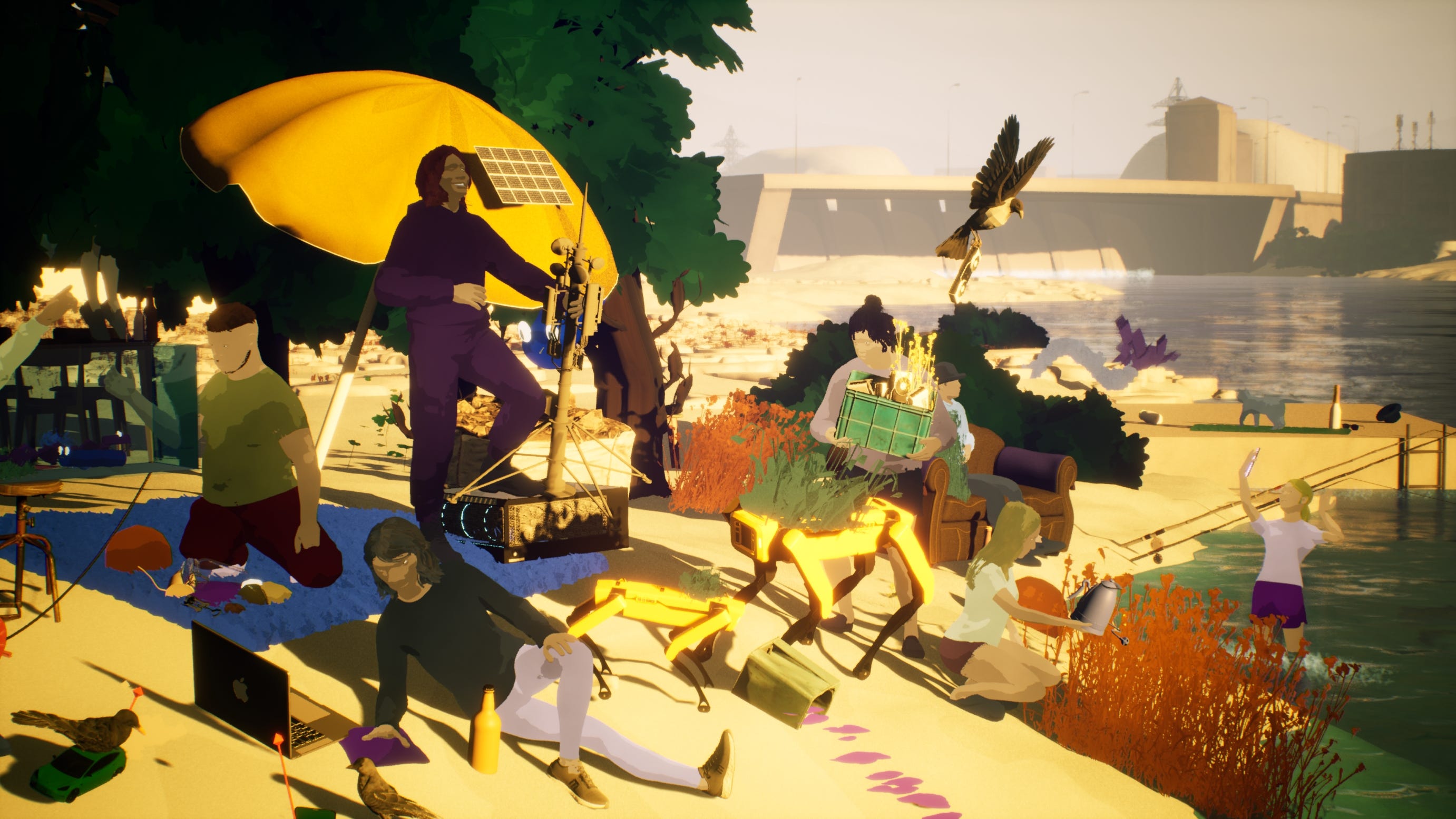
The creation of Romanian artist Cezar Mocan, World Upstream (2023-2024) is a real-time simulation artwork that was built in Unreal Engine. Possible to position as a descendent of the systemic game genre - in which complex interconnecting systems permit emergent events that might form pocket narratives - the experience of watching World Upstream live is one in which still periods are suddenly broken by a cascade of events. One actor in the system may suddenly find itself inclined to pick up a chair and run across the screen, setting off a chain of events and by doing so permit the viewer the opportunity to read meaning from a chaotic assembly of interacting desires.
In our conversation I asked Cezar to delve into some of the reasoning and AI systems that underpin these relationships, and asked whether the non-playability of the system he created could be interpreted as a commentary on agency in a world where humans have made their own labour unnecessary.
Since its inception, World Upstream has been shown at multiple venues and in various contexts. Including group exhibitions Sandbox Mode (2023) at OFFICE IMPART, Berlin; Tellurian Traversals (2023) at Putty’s Coronation, New York City; Beyond Human (2024) at Artemis Gallery, Lisbon; and [Hypertext](Hyperlink) (2024) at the CCAM at Yale University, New Haven. It has also been presented in talks with Onassis ONX, New York City and was awarded the ‘Emerging Artist’ prize as part of the ABS Digital Art Prize 2025.
Side Quest: World Upstream takes place within a speculative future that is materially familiar yet posits the widespread adoption of labour replacing AI technologies, achieving what we might call a condition of absolute universal basic income for its citizenry. Potentially even more than basic income, abundance maybe. Under these types of conditions we might imagine the resolution of certain types of human agency and the transition to a machine operated and orchestrated world. Reminiscent of the closing chapter of Asimov’s I, Robot (1950) and possibly hinting towards Lovelock’s Novacene (2019). Whilst in terms of computer gameplay it reminds me of Alexander Galloway’s distinction between “machine actions and operator actions”. (2006, p.5) I’d like to begin our conversation by asking if you could provide a little further context about the world you’ve imagined and what exists outside the frame? As well as how the conditions of labour and agency in this world - their reduction - might be aligned with the choice to craft World Upstream as a simulation with no playable factor?
Cezar Mocan: Somewhere in the opening chapters of Eye of the Master: A Social History of Artificial Intelligence, (2023) Matteo Pasquinelli makes an argument about how, in ancient societies, the symbolic notation for numbers emerged from embodied rituals around the exchange of goods. These very physical, communal acts become a basis for abstraction. On a mechanical level, World Upstream functions as an a-linguistic society: the characters ‘communicate’ with each other through embodied behaviors (aka proto-rituals), rather than symbols or language. And it makes me wonder, what are the abstractions that could be developed by a collective of *beings* whose [social] needs are less concerned with avoiding scarcity.
That’s maybe a future-looking response to the question of what exists outside of the frame. If we were to turn to the past, the answer might be ghosts. During the research phase of World Upstream I was reading parts of Anna Tsing’s Arts of Living on a Damaged Planet, (2017) which introduces this re-framing of a ‘ghost’ as a past that could have been, as ecosystems and entities that are no more, but live through in material or immaterial ways. She says:
“As humans shape the landscape, we forget what was there before. Ecologists call this forgetting the “shifting baseline syndrome”. Our newly shaped and ruined landscapes become the new reality. Admiring one landscape and its biological entanglements often entails forgetting many others. Forgetting, in itself, remakes landscapes, as we privilege some assemblages over others. Yet, ghosts remind us.” (ibid. p.G6)
The setting around the dam is important here. I’m interested in the dam as this site of technological [almost] obsolescence. These hydroelectric dams were symbols of progress, of harnessing nature for human productivity, progress. Now they sit there, infrastructuralized but aging, culturally forgotten. And I’m trying to think about AI in a similar way—not at the peak of its hype cycle, but after, when it’s become mundane, taken for granted, absent because it is omnipresent. Jussi Parikka talks about “zombie media” in the context of electronic waste never fully disappearing, and about how the [planned] end-of-life for a technological product can also become a moment to celebrate, a moment when that artifact is reclaimed by the community. (Hertz and Parikka, 2012, p.427) I see the dam in World Upstream in a similar way, a piece of zombie infrastructure, slowly taken over by an ecosystem.
But the work exists in the present, and it’s a present that’s frozen: even though things are happening, in some ways the speed of passing time is set to zero. It’s always Sunday afternoon in the late summer, it’s always sunny, the shadows always fall at the same angle. Which is a utopia; or tyranny depending on how you look at it. The picnic goes on forever, yet time doesn’t pass. Genre painting was a big source of inspiration in developing this work, and it’s possible I appropriated the stillness of those images – their suspension of a moment – to the temporal structure of the simulation.
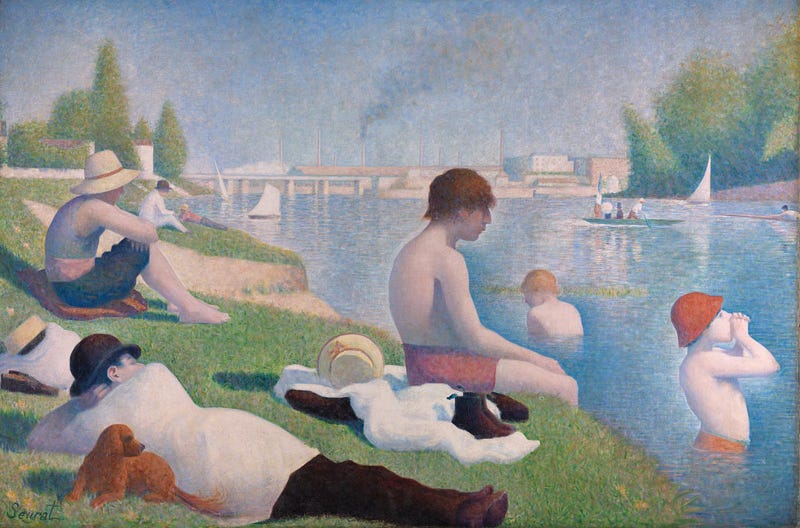
SQ: That illusion to an always Sunday afternoon and the forever picnic is deeply evocative of George Seurat’s paintings. I would say partially A Sunday Afternoon on the Island of La Grande Jatte (1884) because of its bourgeois tone and the playful activity unfolding, but maybe more so Bathers at Asniéres (1884) thanks to the line of factories sitting on the distant shoreline beyond the foreground figures. Both are very frozen moments, facilitated by the affordances of then modern industry.
CM: This temporal stuckness also relates to why the work is non-playable. Traditional gameplay relies on time as progression, you play ‘toward’ something, and your movement through the game becomes a clock in itself. Sometimes in quite literal ways (think Steam’s ‘Playtime’ metric). In Galloway’s terms, I like to think of the ‘operator actions’ as the hour and minute hands of an analog clock, and the ‘machine actions’ as the seconds. A game’s progression follows you - the player, the subject - not the NPC, so there is often a clear hierarchy there.
The moment you remove the hours and minutes from a clock, you’re suddenly left with a time measurement device that doesn’t show the capital ‘T’ Time anymore; it now shows change, in increments of one second. Which can feel disorienting. Or addictive. In a similar way, I think the removal of playability de-centers the subject in a way, or forces you to think on different scales. You’re left to witness machine actions responding to machine actions, knowing that by design you can not intervene, no matter how much you want to. And I believe the impossibility of fulfilling this desire opens up a space for contemplation, for projection, for observation. Which feels appropriate for a work framed around a post-labor society. It’s not a commentary on reduced agency, as much as an acknowledgement that this binary — player versus played, operator versus operated — doesn’t hold up in the kind of world I’m imagining.
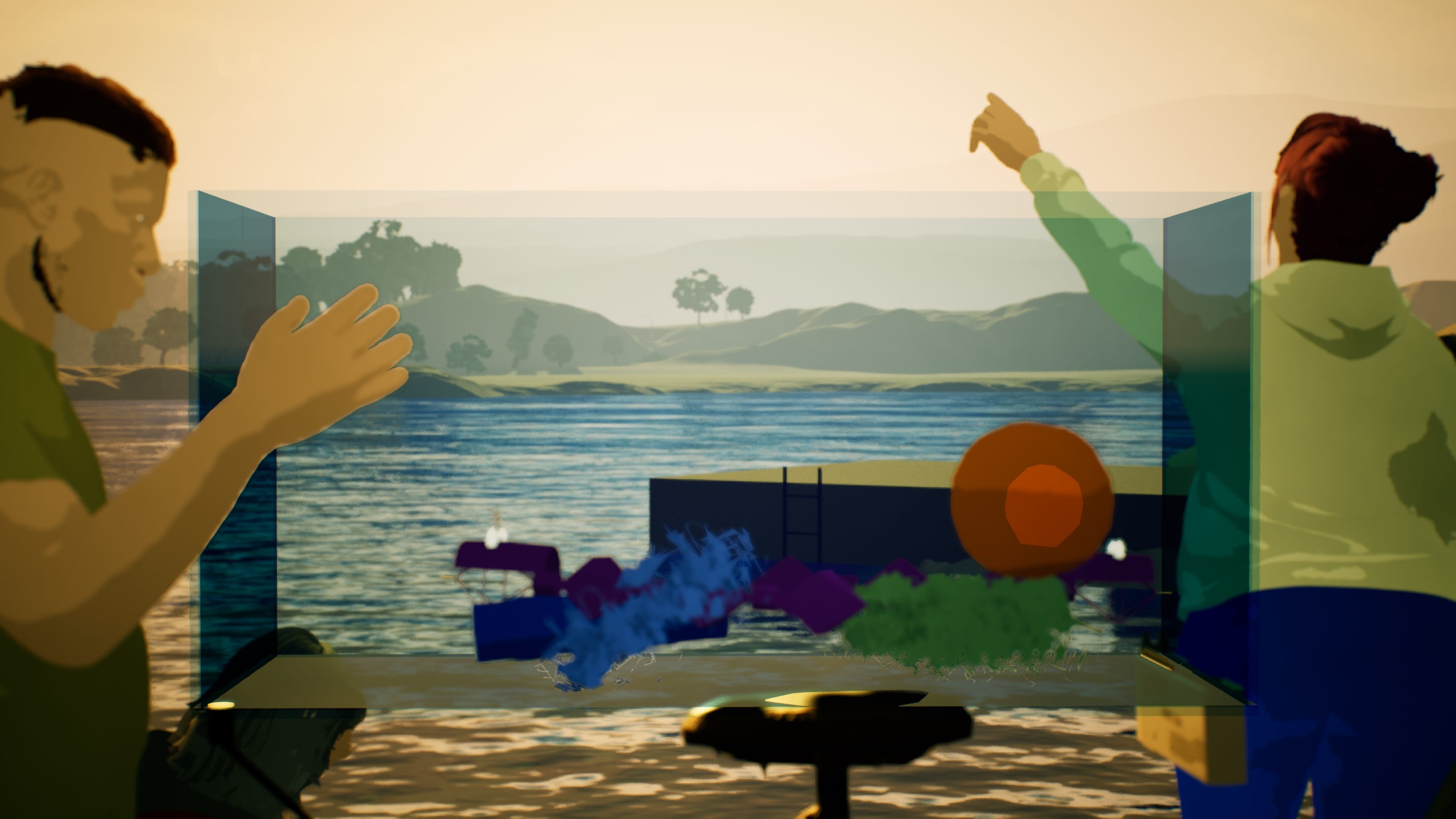
SQ: If it’s OK I’d now like to turn to the crafting of the artificial systems. In the artwork’s presentation document you mention that each of the inhabitants, where a virtual rendering of a “living being, inanimate object or elements of infrastructure” are driven by a “cognitive architecture rooted in five different desires”. (Mocan, 2024, p. 18) This immediately made me think of the AI logics used to animate characters within The Sims (2000) and a Gamemakers Toolkit video I watched several years ago describing how Maxis motivate the Sims in relationship to ‘Hunger’, ‘Comfort’, ‘Hygiene’, ‘Bladder’, ‘Energy’, ‘Fun’, ‘Social’ and ‘Room’. All being scored from -100 to +100 and differing priority curves amplifying these scores to differing degrees. (2023) These needs differ greatly from the desires you’ve chosen, ‘Nostalgia’, ‘Nesting’, ‘Curiosity’, ‘Cacophony’ and ‘Togetherness’. Could we uncover a little of what each of these terms means and what types of AI mechanics activate them? And I’d also be very interested to know if the priorities of different agents within your simulation are different, based on whether for example they’re a human, a poplar tree or a vacuum cleaner?
CM: The Sims lineage is definitely there, and so is the work of other artists who’ve explored this angle long before I have, Ian Cheng being the first one who comes to mind. I’ve probably read more about The Sims than I’ve actually played it, but Will Wright’s approach to distributed intelligence has been really influential. There’s this paper by Jeremy Tirrell called Dumb People, Smart Objects that breaks down how Wright designed The Sims with what he called a “proximity pheromone” model—objects broadcast their affordances to the Sims, and the Sims are more-or-less filters deciding which broadcasts to respond to. (2012, p.4) Wright explicitly said he made “the people really dumb and the environment and objects really smart.” (ibid.)
“Everything is a little dumb, and a little smart. The poplar tree, the Dyson vacuum, the humans, the robot dogs—they all run on the exact same cognitive architecture.”
I’m interested in a similar approach, but with an inversion. In The Sims, there’s still this implicit hierarchy where humans are the protagonist category (even if they’re “dumb”). What I wanted to do was collapse that distinction entirely. In World Upstream, there is no difference between people and objects. Everything is a little dumb, and a little smart. The poplar tree, the Dyson vacuum, the humans, the robot dogs—they all run on the exact same cognitive architecture. The only distinction is in the weights each desire gets for each character, which creates different ‘personalities’. In assigning these personalities, I’ve tried to be agnostic of the material substrate of each character (vacuum or human, etc.) and focus more on how the system is balanced and what kinds of surprising interactions might emerge.
The desires themselves in some ways operate in a post-homeostasis moment. In games, there’s usually this goal-directedness – unlocking, progressing, leveling up. The Sims have survival needs: hunger, bladder, hygiene. None of that exists in World Upstream, because there are no existential threats to the characters. So instead the agents are driven by these more abstract, almost emotional and social desires.
Nostalgia is about seeking out the familiar, gravitating toward objects or locations that have been visited before, a pull toward the past or what feels like the past. Curiosity is its opposite – attention to the new, unexplored areas, objects that haven’t been interacted with yet. These two are constantly in tension.
Nesting is about settling, creating space, arranging things, staying in one place. Cacophony is the opposite impulse – disruption, movement, creating chaos, picking something up and running with it across the landscape. These desires play off each other too.
Togetherness is the social desire, wanting to be near others, to gather, to form these temporary clusters.
The technical framework this logic falls under is called a utility system, or utility AI: a decision-making scaffolding where each possible action gets assigned a score based on how well it satisfies the agent’s current needs or desires. The agent evaluates all available options and picks the one with the highest utility score. It’s maybe a bit ironic—using a utility-based system for a simulation that holds anti-utility as a goal.
Each agent has its own set of weights for these five desires—so one character might have very high ‘Nostalgia’ and low ‘Cacophony’, while another might be the opposite. At any given moment, the agent calculates which desire is strongest based on its current state and the environment, and pursues that. A character with high ‘Nesting’ might spend a lot of time arranging objects around a favorite spot, but if their ‘Curiosity’ gets triggered by something new appearing in their field of vision, they might suddenly abandon that and go investigate. It’s this constant recalculation that creates the sense of personality, or what looks like personality from the outside.
SQ: And to double-check, your agnostic approach means that each agent’s individual weighting of the five desires is randomised? Irregardless and uncalibrated in relation to a projected notional characterisation of how humans and parasols may differ. Like the character-creation screen of an RPG, does each agent have a set amount of XP distributed across the desires? Or instead of a predetermined quota is there another system at play determining the amount of personality they have?
CM: Exactly right. Each agent gets a randomized personality, a parasol might have higher ‘Togetherness’ than a human, a vacuum cleaner might be more ‘Curious’ than a robot dog. There’s no correlation to what these entities are or do in the real world.
The distribution works a bit like the XP model you mentioned, but it’s not normalized. So it’s less about the absolute values and more about the ratios between desires. One character might have scores of [.3, .1, .5, .05, .2] while another has [.6, .2, 1, .1, .4], different magnitudes, but similar personality profiles because the ratios between the desires are the same.
Calibrating the whole system is honestly one of the most enjoyable parts of building a simulation like this. Once the core mechanics are in place, it becomes this iterative process: watch for 5-10 minutes, take notes on what feels off or interesting, adjust the weights, repeat. It’s tuning the balance of the entire ecosystem through tuning individual personalities — making sure there’s enough variety that the world feels alive, but not so much chaos that it becomes unreadable.
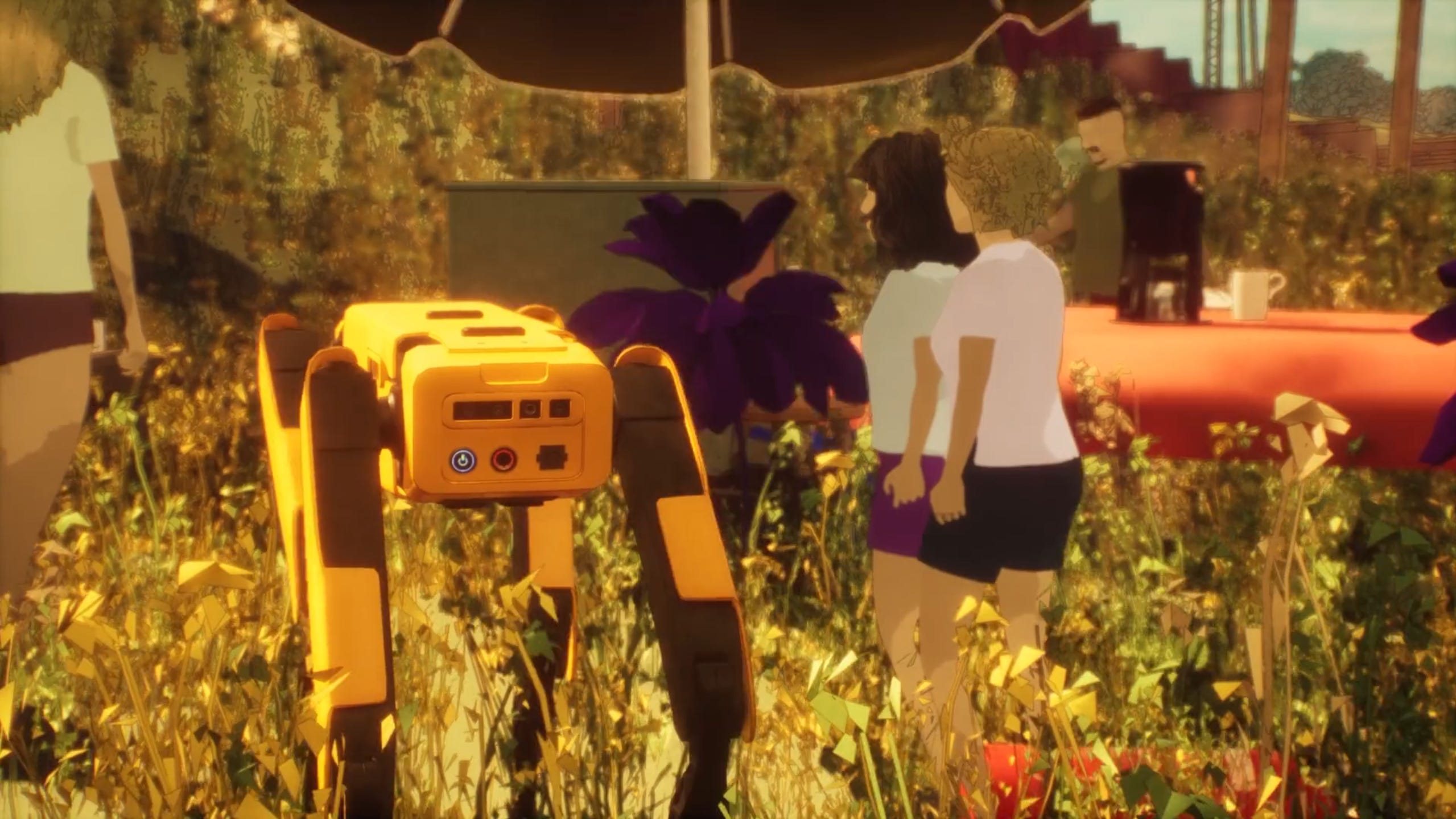
SQ: The other character we’ve not yet mentioned is the camera. Personally I would call this the closest approximation of a central protagonist that World Upstream has. Whilst other non-playable-characters enter into frame and might become focal points of what you’ve called the “proto-narratives” of expanded cinema, the camera is consistent throughout. (Mocan, 2024) Determined by its own set of logics, it is the filmmaker. From the online preview of the work, I get the sense that it attaches itself to a given agent and akin to a third-person computer game follows them, switching between rotational and tracking set-ups. I’d like to know more about the rules and decision making behind the camera, and whether you experimented with other variations or would consider doing so in future displays?
CM: You’re spot on about the mechanics. The camera follows an individual character for a while, focusing either on the character themselves or on their object of attention — whatever they’re looking at or moving toward. After a certain duration, it switches to a different character, with more priority given to nearby ones if they exist. Every now and then it also holds still shots within the environment, just observing the landscape without a specific subject.
I love your framing of the camera as a [main] character in the simulation, I never saw it that way during development, but you’re right, it totally is. Maybe I categorized it differently because it follows a different set of rules than the agents, it’s more prescriptive. And it’s always felt more like the medium through which World Upstream presents itself to the viewer, rather than a member of the cast.
What does the camera do when it’s in a ‘Cacophony’ state? Does it cut rapidly, shake, zoom erratically?
But now I’m wondering what it would mean for the camera to be driven by the same five desires. What does the camera do when it’s in a ‘Cacophony’ state? Does it cut rapidly, shake, zoom erratically? When it’s ‘Nostalgic’, does it linger on locations it’s filmed before, return to favorite subjects? Which raises the question of who the camera becomes in this world. Is it a once-removed proxy for you, the player? Is it a once-removed proxy for me? Is it the subjective perspective of a character we never get to see? Or is it simply ‘The Camera’? I don’t know how to answer this question.
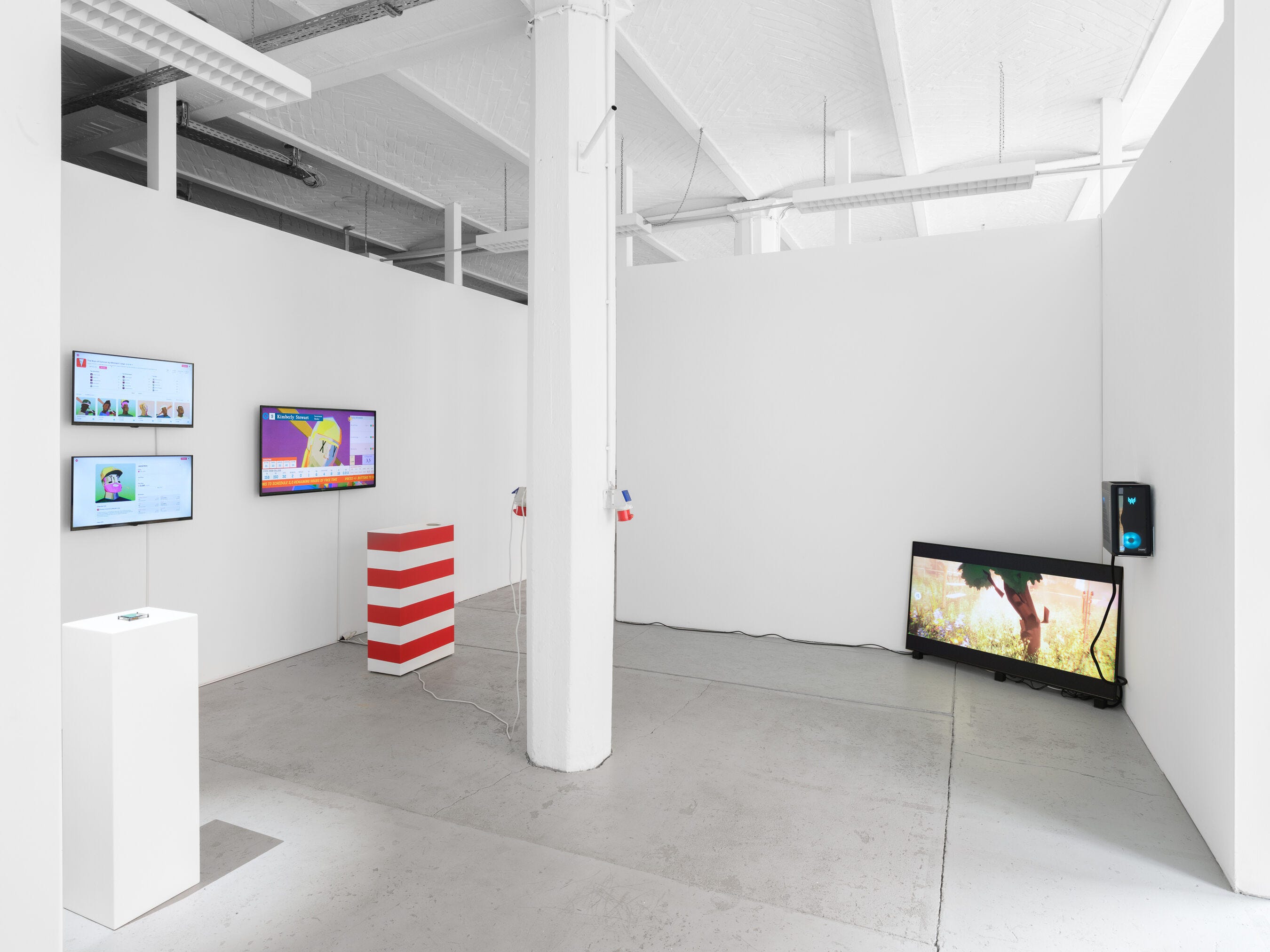
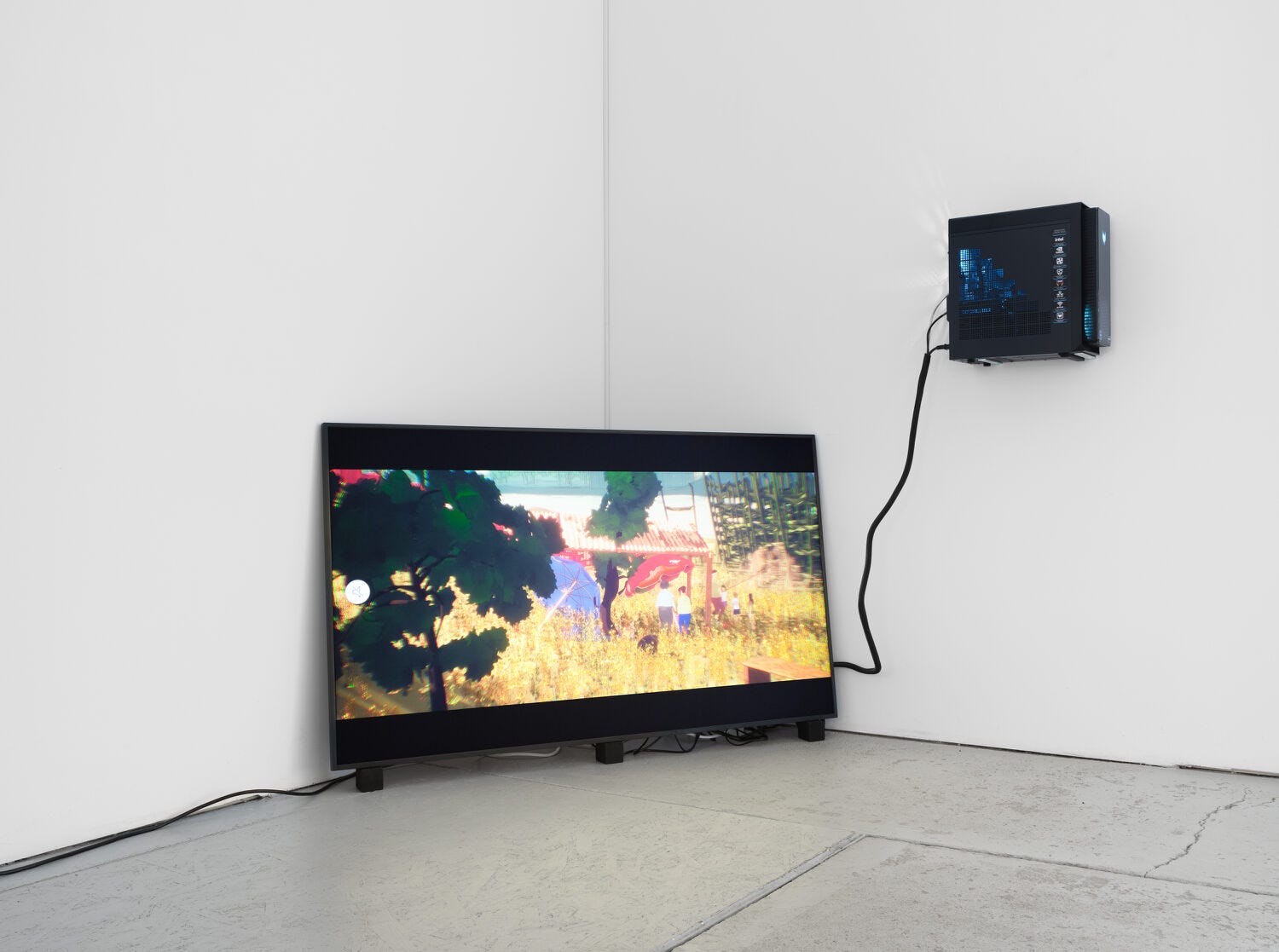
In its current version though, it might be closest to an algorithmic version of how my attention works when I’m in the Calouste Goulbenkian museum garden during the spring, when ducklings start showing up.
I recently learned about Harun Farocki’s concept of ‘soft montage’. He uses it to describe a way of juxtaposing images that creates “a suggestive—not expository experience—for the viewer.” (Coco, 2018) In his work, the concept operates within a deeply political framework. To an extent, it applies to what I’m trying to do in World Upstream (and other generative video works as well), with a focus on getting the viewer to inhabit the work’s diegetic universe by filling in the gaps created by the imperfect image sequencing, and conversely the world starting to find a place in the viewer’s mind. It’s a way to access that liminal space between the viewer and the artwork.
SQ: And our consistent final question, what games and gaming experiences have impacted you most as an artist and if it’s possible to say, specifically in relation to World Upstream?
CM: To be perfectly honest, painting has been more influential for this project than games. Especially contemporary Romanian landscape painters like Șerban Savu — this post-socialist realism where figures exist in landscapes alongside these very specific architectural or technological remnants from the communist period. Concrete fences, old trucks, brutalist apartment blocks being slowly reclaimed by nature. Of course, their work speaks to me because my body recognizes that assemblage of concrete and weeds – I grew up in it – but it’s also got so much to do with the other side of what we call ‘progress’ — infrastructure becoming natural landscape, rather than the opposite. The built environment slowly getting absorbed back into the world around it, making its material conditions of existence visible again.
But going back to video games, I have a strange relation to them—I’m a gamer for more or less one day a year. I get too addicted if I start, so I have to stop after I exhaust myself once. The last time that happened I played Sable, (2021) I fell in love with its visual style, character design, the Japanese Breakfast soundtrack and its slow pace. Previously, it was Hades, (2019) multiple times. You play as Zagreus (son of Hades) and repeatedly try - and fail - to escape the Underworld. I have a soft spot for spirals as a formal device, and that game is one big, addictive, chaotic spiral.
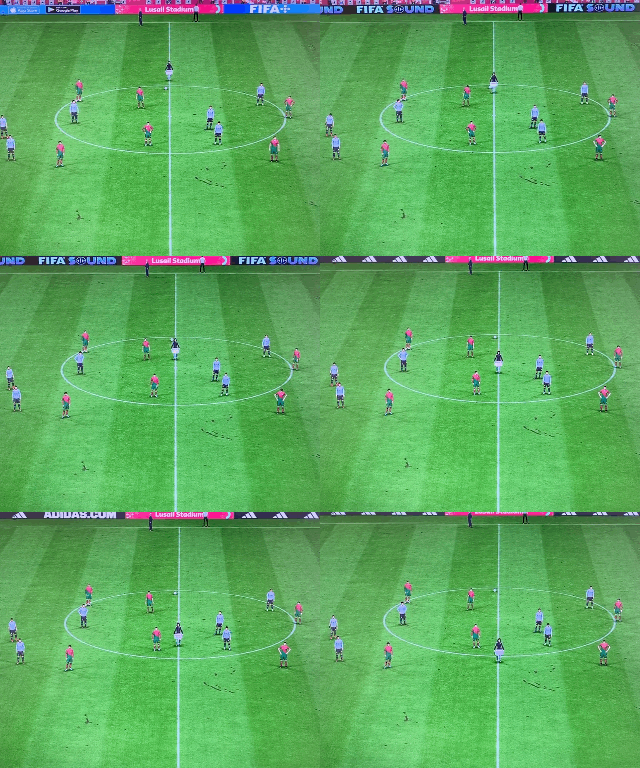
For nostalgic reasons, a few years ago I really wanted to play FIFA (1993-2022) on my birthday. Four or five games in, I was exhausted but couldn’t stop playing, and I encountered maybe the most beautiful glitch I’ve ever witnessed. Both teams refused to re-start the game after half-time. The players were stuck in limbo, evenly distributed on the field, facing the camera and looping their idle animations, while a staff member I’d never seen before zealously carried a crate of equipment from one side of the pitch to the other, over and over. I loved their refusal so much that I quit the game and uninstalled the software. I think of my encounter with those 22 players, one referee and one staff member sometimes. I wonder if they’re still resting.
SQ: I think that’s a brilliant note to close on. A stray line of code in FIFA that carries with it the potential for all players on the pitch to enter into a perpetual “ambience act”. (Galloway, p.10) As if the game in its own obsolescence had become a sort of zombie infrastructure that consciously chose to end the literal labour of play. I’m glad you got to witness that.
Cezar, this was great, thanks again so much for your time and sharing the theoretical and technical ideas shaping your practice. Very much looking forward to seeing where you practice goes in 2026.
Forthcoming, Cezar will be showing his new project A Field Guide to Orbital Melancholy as part of the upcoming group exhibition DRIFTS (January 22 - March 6, 2026) at OFFICE IMPART, and later in the year at Coleccion SOLO in Madrid, as part of the SOLO AI’25 Award.
Bibliography:
Isaac Asimov (1950) I, Robot. Gnome Press.
Rhian Daly (2021) Japanese Breakfast on how she crafted the score for ‘Sable’. Composer.
Mark Brown / Game Maker’s Toolkit (2023) The Genius AI Behind The Sims. YouTube.
Alexander Galloway (2006) Gaming: Essays on Algorithmic Culture. University of Minnesota Press.
Lucia Coco (2018) What Do Images Do: Looking Through Harun Farocki. Brooklyn Rail.
Harun Farocki (2008) ‘Cross Influence / Soft Montage’, in Harun Farocki: One Image Doesn’t Take the Place of the Previous One. Leonard & Bina Ellen Art Gallery.
Game Design Thinking (2021) Replicating Real World Systems.
Garnet Hertz and Jussi Parikka (2012) ‘Zombie Media: Circuit Bending Media Archaeology into an Art Method’, in LEONARDO, Vol. 45, No. 5.
James Lovelock (2019) Novacene. Allen Lane, Penguin Books.
Cezar Mocan (2024) World Upstream Presentation Fall24. cezar.io.
Matteo Pasquinelli (2023) Eye of the Master: A Social History of Artificial Intelligence. Verse.
Jeremy Tirrel (2012) Dumb People, Smart Objects: The Sims and the Distributed Self. The Philosophy of Computer Games Conference.
ed. Anna Tsing, Nils Bubandt, Elaine Gan and Heather Anne Swanson (2017) Arts of Living on a Damaged Planet: Ghosts and Monsters of the Anthropocene. University of Minnesota Press.
Gene Youngblood (1970) Expanded Cinema. P. Dutton & Co., Inc..