

CCC Video Game Writing 2026
...with Fifi Chang addressing virtual natures and Angelo Sanchez Dela Cruz on avatar body modification.


Every year I have the good fortune to spend a portion of my working day supporting the research and writing endeavours of some incredibly smart young people. As a lecturer on BA (Hons) Culture, Criticism and Curation at Central Saint Martins the 2025-2026 academic year has been no exception, so now on summer break I felt it important to celebrate the writing of two students – Fifi Chang and Angelo Sanchez Dela Cruz – who’ve stood out for me and who I feel have made and will go onto make contributions to the academic arena of computer game studies. Or add to the field in some other amazing creative manner!
But before introducing and sampling from the students’ writing, a little about the course itself. BA (Hons) Culture, Criticism and Curation could maybe be imagined as a curatorial studies course that expands the remit of what can be curated well beyond the art historical or contemporary art contexts that typically shape masters degree programmes. Students are encouraged to view any and all cultural materials as worthy of critical investigation and as curatorial substances, as well as embracing the acts’ social potential as traced through its etymological roots from the Latin cura, meaning to care or heal. In practice this means more discovery. A surfacing of niche interests and students who by the end of their studies have diverged into a spectrum of areas that are frequently unpredictable and keep the teaching staff on their toes.
A student may direct their studies towards a feminist icon of Mexican cinema’s golden era or the parallels between Japanese maid cafés and AI companions, I’ve second marked an excellent text on the Brazilian Butt Lift in the same year that I supervised a dissertation on the meeting point between Indigenous fire prevention strategies and Californian bureaucracy, students have addressed questions of intangible cultural heritage preservation via the queer-pop figure of Rodrigo Cuevas and elsewhere structured the pros vs cons of using blockchain to monitor auction sales in the art market. Set alongside this breadth of inquiry video games have become an increasingly prevalent subject to the point that one second year unit now requires a dedicated essay tutorial group for the medium. In 2026 alone we read submissions on Arknights (2020) and Stardew Valley (2016) as respectively critical and cosy utopias, Death Stranding (2019) as anti-capitalist practice, the experience mechanics of LSD: Dream Simulator (1998), growing up within the panoptical conditions of Move Start Planet (2009) and playable orientations in Sweet Home (2025).
Copied below are sampled extracts from Fifi Chang’s final year dissertation Nature in Pixels: Exploring World Generation, Player Action, and the Construction of Nature in Video Games and Angelo Sanchez Dela Cruz’s second year essay titled The Body That Was Never a Body: The Omnivorous Gaze and the Leasing of Synthetic Flesh in Marvel Rivals. Growing up in rural Taiwan before moving to the city, Fifi’s writing on systemic rendering of natural environments is steeped in their own reconnection with the landscape through computer games. In their dissertation they apply theory by Alenda Y. Chang and Alexander Galloway, amongst many other academics, to an examination of world generation and crop cultivation in Minecraft (2009/2011) and Stardew Valley (2016). Concerned with avatar body modification in Marvel Rivals (2024), Angelo’s essay establishes the ‘omnivorous gaze’ by layering concepts from Jean Baudrillard, Laura Mulvey, Judith Butler, the Proteus Effect, Henry Jenkins and Bo Ruberg to ultimately examine whether player modification subverts the engine’s gendered coding or quietly extends it.
Both are truly excellent examples of what these young writers can achieve and if you would like to read either Fifi or Angelo’s writing in full please reach out to them. Their contact details are: Fifi Email / Fifi Instagram / Angelo Email / Angelo Instagram.
Chang, F. (2026) Nature in Pixels: Exploring World Generation, Player Action, and the Construction of Nature in Video Games.
Extract #1.1 from ‘Introduction’.
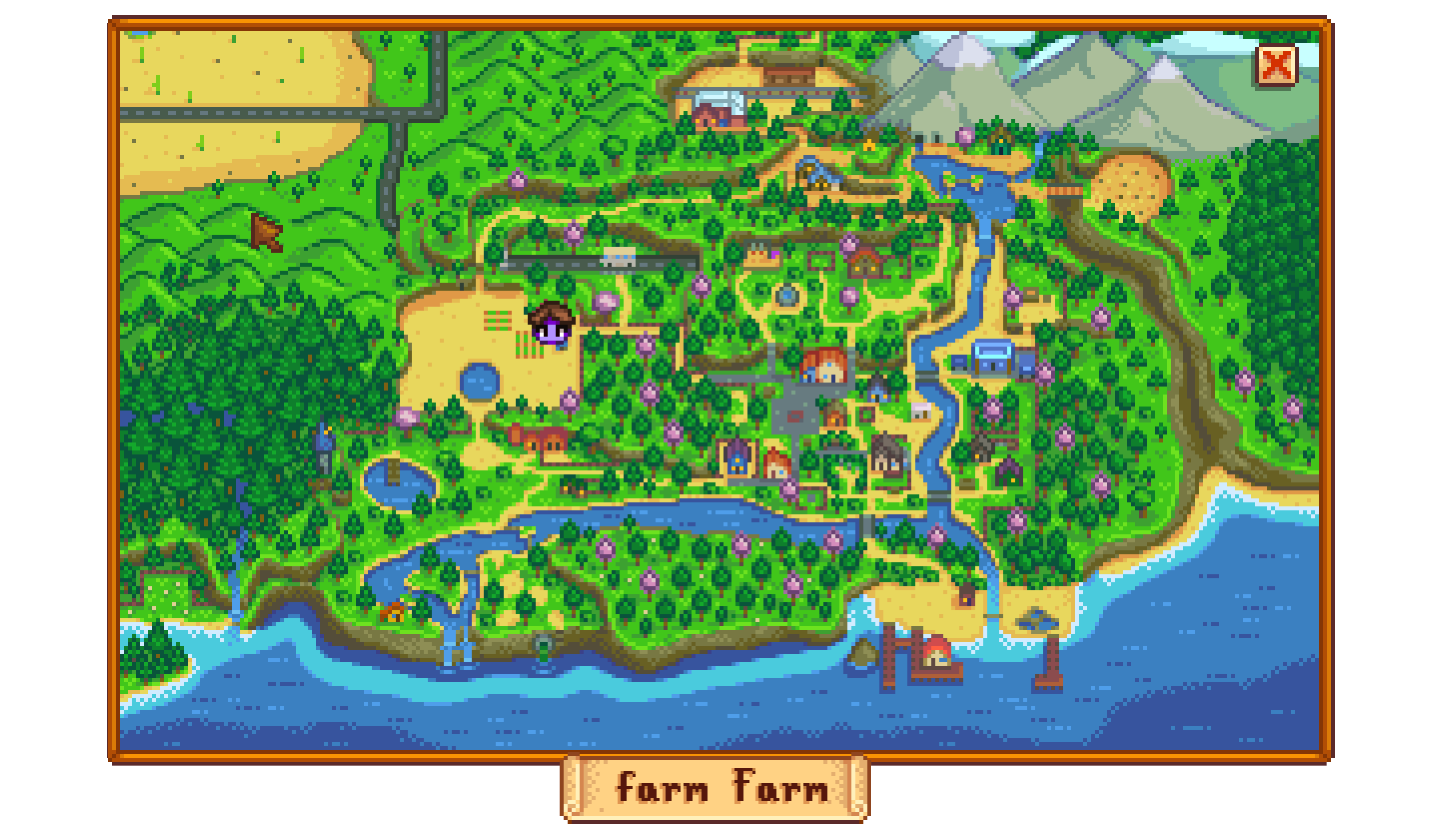
When I was a child, the word “nature” felt quite simple. It meant the humid summer air, the way my ears rang from cicadas buzzing, and how my hands smelled after picking ginger lilies by the waters. It meant the mountains and forests, and equally the typhoons and earthquakes, that shaped my childhood in rural Taiwan. Years later, now living in the city, I sit before the pixelated fields of Stardew Valley and the blocky landscapes of Minecraft. Traversing their digital environments feels like a return to those rhythms of my childhood, the same pulse of curiosity and playfulness, yet the soil beneath my cursor is different, and the world here unfolds through pixels and codes. It is from this shift that this dissertation begins, tracing how video games construct their own ecologies of play, and how these digital environments shape the way we come to know, feel, and inhabit nature.
Video games have become one of the most pervasive ways contemporary culture encounters and imagines environments. The fast-changing and interactive nature of the video game industry (Goh et al., 2023, p.1) underscores its idiosyncrasy as a cultural form. While insights from entertainment fields such as film, music, or literature can inform the study of video games, the video game industry is shaped by a number of unique production conditions and textual structures, in which meaning emerges through systems, rules, and player interactions, rather than representation and spectatorship alone. From pastoral farming simulators to expansive procedurally generated worlds, games frequently invite players to cultivate land, traverse landscapes, and interact with nonhuman systems. Existing scholarships productively explore how such digital environments convey nature and environmental value, yet less attention has been paid to how ecological meaning is produced through gameplay mechanics and actions themselves. Reading forests, terrains, and ecosystems as visual backdrops or narrative settings, without considering the procedural logics that govern world construction and player intervention risks overlooking how games actively produce environmental meaning through play.
This dissertation hence argues that video games construct nature not only through visual representation or narrative framing but also through the procedural systems and algorithmic constraints that shape play. Mechanics such as growth cycles, resource generation, and spatial constraints shape how players come to understand care, responsibility and agency in relation to digital nature.
Extract #1.2 from ‘World Generation and Exploration - Exploration and Ways of Inhabiting’.
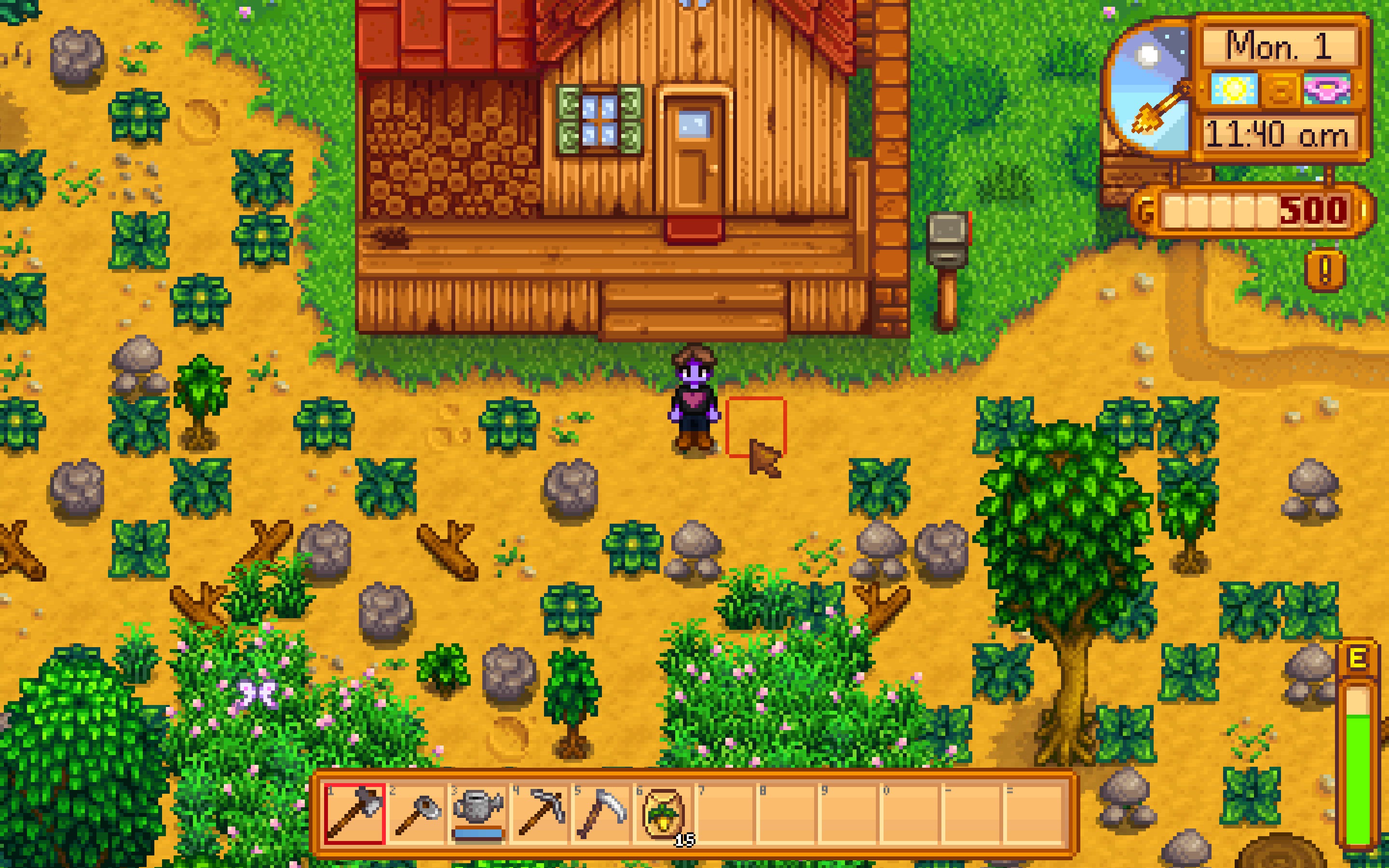
As spatial boundaries shape how worlds are encountered, they also condition the range of actions that appear meaningful and desirable within them. Following Galloway, these actions emerge through the interaction of machine processes and operator input. In Stardew Valley, hard boundaries privilege repetitive, optimisable actions over exploratory or improvised play. The game’s discrete zones and the subsequent hard boundaries is a design choice that fragments space into manageable units, thereby presenting nature as discontinuous. Through each transition, between the farm, Cindersap Forest, or the beach, player actions are suspended and the spatial contexts are reset. This interruption discourages the immersion in environmental continuity and instead frames each area as a functional site with a specific purpose, such as production, foraging, or extraction.
The game’s lack of environmental autonomy can be emphasised through the player’s first interaction with nature in Stardew Valley. When arriving at the dilapidated farm in Pelican Town, the player’s first task is not exploration nor observation, but clearing. The game’s procedural logic through the debris-strewn farm, presents nature as a disorder that must be disciplined before it can become productive. With the immediately-provided tools, players perform operator acts, clearing weeds, rocks, and fallen logs to allow for farming and other activities. Importantly, this labour is framed as restorative rather than extractive. Clearing the land is narratively positioned as healing a neglected space, aligning with environmental mastery with care and stewardship. Yet, this clearing nonetheless effaces the small ecologies already at work, beetles in the soil, woodlice in the rot, lichens patiently inhabiting what the game names debris. The unchanging farm size, shape, and terrains encourage a long term optimisation, as players build paths to permanently prevent the appearance of debris, and arrange crops for maximum yield, nature becomes more legible over time, the ecologies already in place evanesce under thick stone slabs.
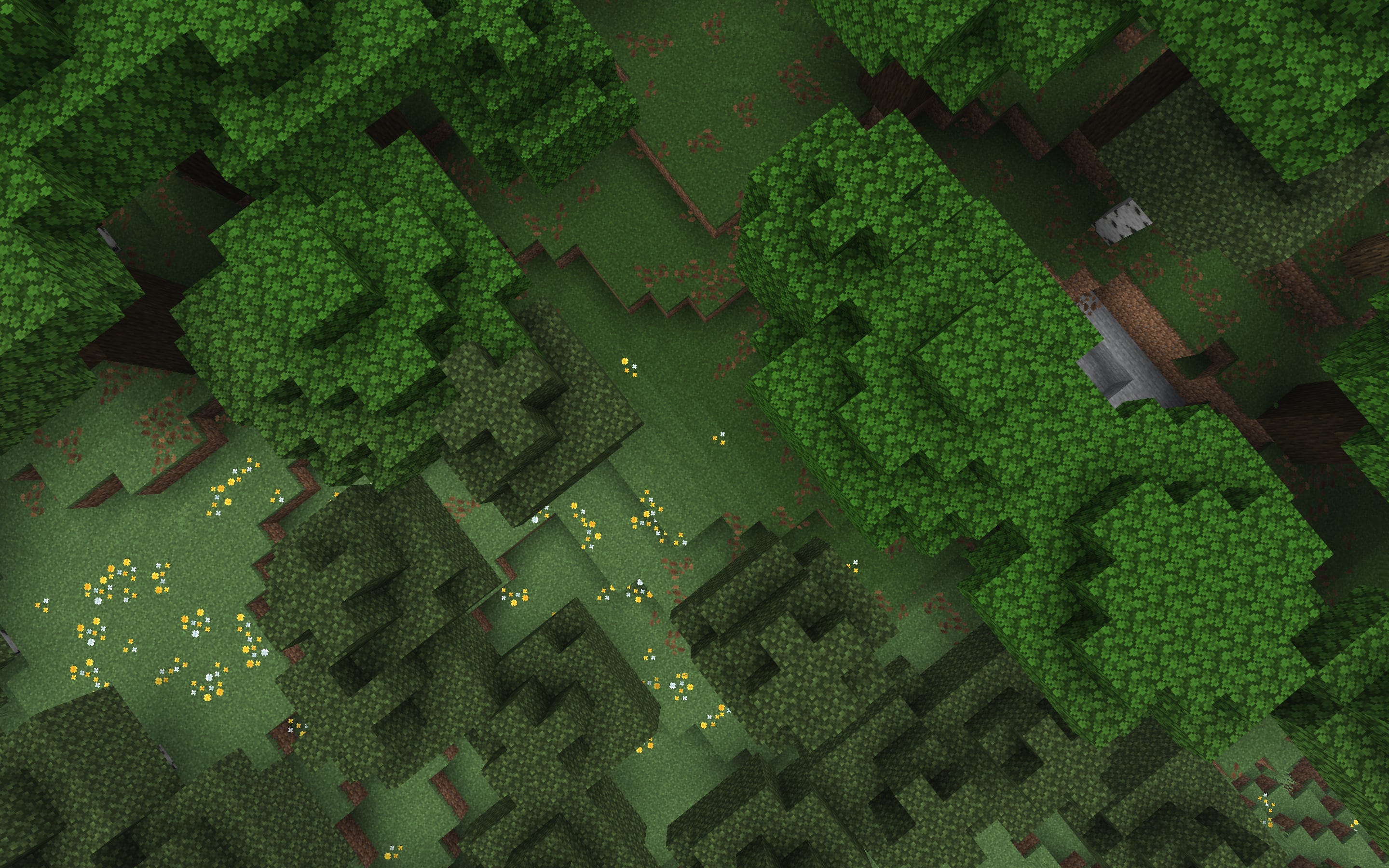
As discussed above, Minecraft’s procedurally generated environment is structured around spatial indeterminacy, the world unfolds incrementally as the player moves, with new terrains generated with exploration…
Extract #1.3 from ‘World Generation and Exploration - When Worlds are Made’.
…the vertical stratification of natural resources. Ores, such as coal, iron, lapis lazuli, and diamond are distributed according to the altitude, their abundance and depth ranges vary between worlds, yet constrained by systemic generative logic.
Beyond the differences in world generation, the worlds of Stardew Valley and Minecraft diverge significantly in how spatial boundaries are constructed. In Stardew Valley, space organisation is what I describe as hard boundaries, meaning the world is divided into discrete, pre-authored zones that are accessed through explicit transitions. For example, Pelican Town and the beach are spatially separated and loaded individually, creating a segmented map with clear and defined edges. The limits of the world are clearly encounterable (Losito, 2025, p.4), making the overall spatial extent fixed across playthroughs.
In contrast, Minecraft’s environment is structured through soft boundaries within a continuous spatial field. Rather than separating space into discrete zones, the game differentiates regions through gradual shifts in large structures like biomes (Phillips, 2014, p.110), as well as smaller elements such as plants and water. What this means is that the colour of plants and water present at the borders of different biomes will be calculated and determined by the biome blend radius, thereby creating a mesocosm that privileges edge-rich environments, visually subtle boundaries and an experientially uninterrupting spatial continuity. The distinction of soft and hard boundaries not only describes how space is technically organised, it also shapes how players inhabit and act within the game environments. Boundaries within a game do not merely act as a hindrance of movement, they also frame the ontology of the game environment itself, through determining whether a space appears to be enclosed and knowable, or processual and open-ended.
Extract #1.4 from ‘Conclusion’.
Together, these cases show that video games construct nature not only through visual representation, they also structure how players come to understand responsibility, agency, and living within an environment. This dissertation is necessarily selective, focusing on two mechanics rather than offering an exhaustive account to leave space for future research to examine additional systems, genres, and play practices.
After this journey, I find myself discerning both digital and physical natures with renewed curiosity and care. From the broad canopy of the sacred fig tree at my countryside home, to the pixels that compose digital landscapes, I have learned to attend to their entwinement and the ways it unfolds across different scales and forms. It reminds me that nature, whether coded or grown, is always relational, always in the making.
Dela Cruz, A. (2026) The Body That Was Never a Body: The Omnivorous Gaze and the Leasing of Synthetic Flesh in Marvel Rivals.
Extract #2.1. from ‘Introduction’.
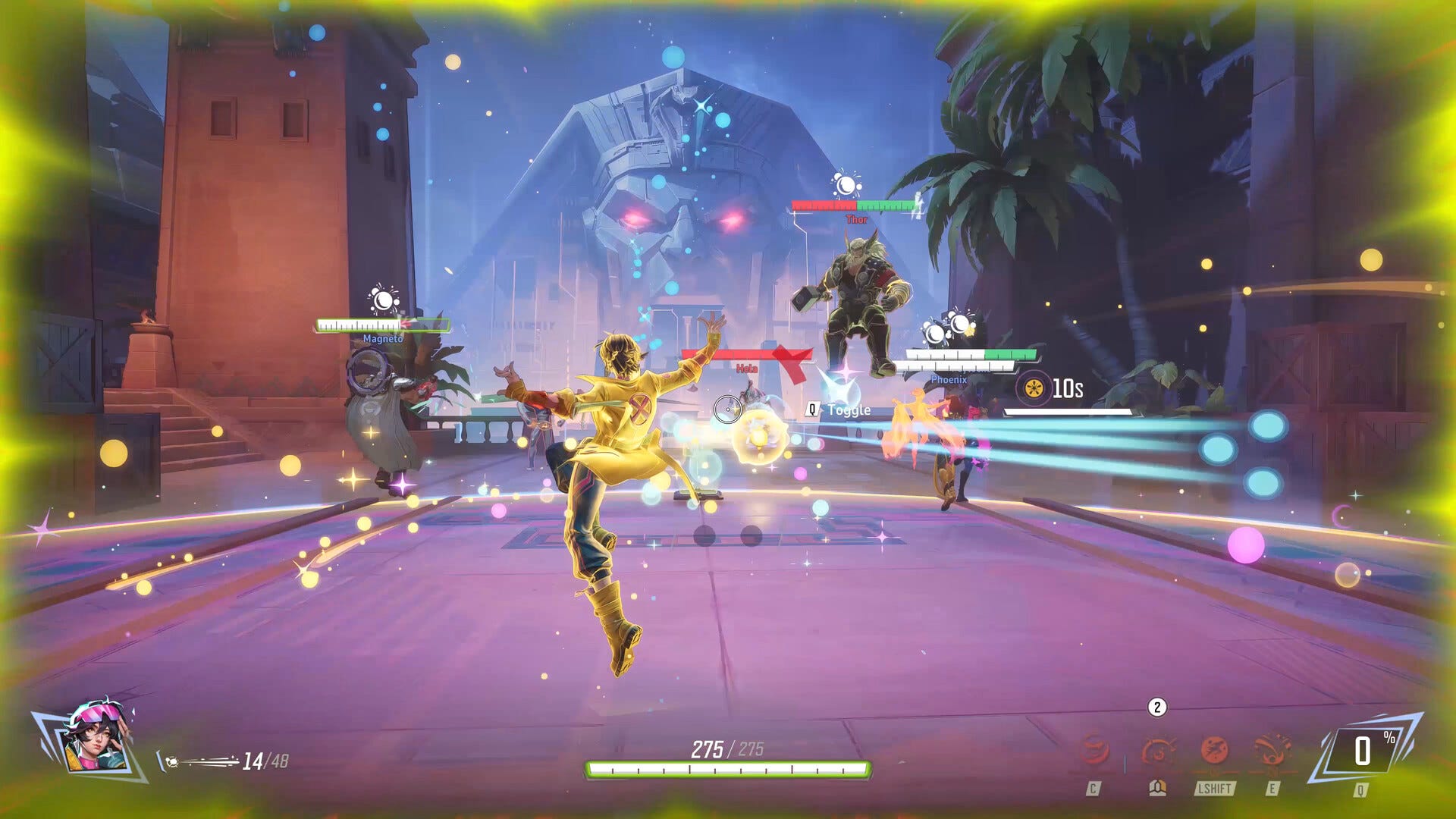
Marvel Rivals launched on 6 December 2024 and gathered twenty million players within ten days (NetEase Games, 2024). Before a single match is played, the hero-select screen makes the game’s real offer: a vitrine of polished, posed, impossibly proportioned bodies, arranged for selection like couture on a rail. At that reach, the rendered body stops being incidental decoration and becomes an argument about what flesh, gender and desire are permitted to look like. This essay reads that argument through three claims held in tension…
Extract #2.2. from ‘The Omnivorous Algorithmic Gaze and the Gendered Economy of the Body’.
…The mass that reads as armoured power on a male frontline body reads on a female one such as Emma Frost, as sexualised abundance: enlarged bust rather than merely enlarged bulk. The narrow body economy is, in other words, gender-neutral in its categories and gendered in its surface.
The decisive detail is that this inscription is not confined to the surface. The anatomy coded for display is the volume the engine registers as targetable: the enlarged bust sits inside the hitbox, and the shoulder pads widening her silhouette across her skins, as direct play confirms, extend it. The enlargement that signifies a powerful, sexualised frontline body is therefore a mechanical liability, since a larger hitbox is easier to strike: the gendered morphology is written into the rules of play, not merely the texture map. The to-be-looked-at body is a coded, quantified disadvantage that refers to no real anatomy at all: the avatar pays, in hit-points, for her own to-be-looked-at-ness.



Extract #2.3. from ‘The poaching case: gender-swap and the denaturalised body’.
…Here the modder is an agent reclaiming the synthetic flesh, and the Proteus effect is, in principle, hacked: a player who reconstructs the avatar reconstructs the conditioning it will exert back upon them.
Yet the primary evidence will not let even this scene stand cleanly, and the complication is more telling than the subversion. Beneath the Female Namor mod, a community member reproaches its maker for insufficient femininity, advising that ‘a big chest, wide hips, a smaller head and some makeup’ are not by themselves enough, and urging attention to ‘the aesthetics people enjoy’ (NexusMods, 2026a). The gender-swap, the practice that most resembles Butlerian denaturalisation, is here being policed back toward a sexualised feminine template by the community itself. Butler’s (1990, p. 33) ‘highly rigid regulatory frame’ has not been escaped; it has been crowdsourced. The audience does not merely tolerate the engine’s gendered coding; it enforces that coding upon modders who deviate, demanding that even a transposed body conform to the established grammar of feminine display. The subversive scene carries its own regulator inside it.
Extract #2.4. from ‘Conclusion’.
The larger claim is therefore Baudrillardian rather than emancipatory. The digital body in Marvel Rivals is not a prison from which modding offers escape into the real, because the body was never a body, and nothing waits beneath the simulation to be freed. It is a hyperreal surface circulating between regulatory frames, each redrawing it without returning it to an origin that never existed. The medium, as McLuhan insisted, is the message: the customisable, surveilled, leasable game body teaches its millions of players that flesh is editable, ownable, and re-claimable by the institution that coded it. To read modding as straightforward liberation is to accept the simulation’s most flattering account of itself. The more troubling conclusion is that in the omnivorous economy of the synthetic body, even the act of rewriting the flesh is folded back into the circulation of the sign.
Fifi Chang is a graduate of BA (Hons) Culture, Criticism and Curation based between London and Taipei. Her practice spans curatorial research, facilitation, and making, with an interest in landscape and belonging, worldmaking, and the imaginative structures that shape how we inhabit spaces, stories, and environments. She is drawn to collaborative and interdisciplinary modes of working, and to practices that sit at the edges of ecology, video games, and alternative ways of knowing.
Angelo Sanchez Dela Cruz is a third-year student of BA (Hons) Culture, Criticism and Curation at Central Saint Martins, writing on visual culture, fashion, and digital space. With a background in anthropology, his work treats garments, avatars and interfaces as evidence of the structures that produced them. He is the founder and editor of THE LEXICON, a forensic visual culture archive he designed and built himself, indexing landmark fashion collections by analytical category rather than by designer.
Thank you again to Fifi and Angelo for allowing their writing to be shared with the Side Quest audience. Here’s hoping for another amazing year of computer game studies on BA (Hons) Culture, Criticism and Curation and that in 2027 we can share with you another set of samples.
Bibliography:
Baudrillard, J. (1994) Simulacra and Simulation. Translated by S.F. Glaser. Ann Arbor: University of Michigan Press.
Butler, J. (1990) Gender Trouble: Feminism and the Subversion of Identity. New York: Routledge.
Galloway, A.R. (2006) Gaming: Essays on algorithmic culture. University of Minnesota Press.
Goh, E., Al-Tabbaa, O. and Khan, Z. (2023) ‘Unravelling the complexity of the video game industry: An Integrative Framework and future research directions’, Telematics and Informatics Reports, 12, p. 100100. doi:10.1016/j.teler.2023.100100.
Losito, M. (2025b) ‘“A train is passing through Stardew Valley”: Post, complex, and Cyberpastoral Video Games’, DiGRA Digital Library, pp. 1–15. doi:10.26503/dl.v2025i2.2467.
McLuhan, M. (1964) Understanding Media: The Extensions of Man. London: Routledge and Kegan Paul.
NetEase Games (2024) Marvel Rivals [video game]. NetEase Games, in collaboration with Marvel Games. Released 6 December 2024 (PC, PlayStation 5, Xbox Series X/S).
NexusMods (2026a) Female Namor - Default [Marvel Rivals mod and comment thread].
Phillips, A. (2014) ‘(Queer) Algorithmic Ecology: The Great Opening Up of Nature to All Mobs’, Understanding Minecraft: Essays on Play, Community and Possibilities. Edited by N. Garrelts, pp. 106–120.
* please note hyperlinks do not necessarily represent the editions of the texts used by Fifi and Angelo, they have been selected to prioritise open access.
** the biographies combined here represent only the citations referenced in the extracts, the full biographies used by Fifi and Angelo are significantly more in depth.
 | A guest post by
|